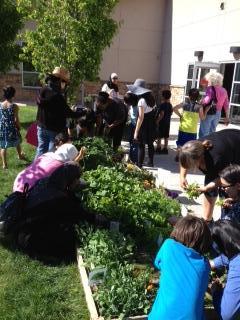
Looking for a fun summer project for your elementary-aged patrons that will combine literacy with learning about science, math, the environment, nutrition and health? Start planning a summer garden club now! Even someone (like me) who has no gardening creds whatsoever can develop a successful program using community experts, online curricula, and gardening colleagues. Turns out real gardeners are quite anxious to help develop new ones!
Last year, seeing that community gardens are springing up around the country, and realizing how much value STEM opportunities offer, I proposed a family garden club at Eloise May Library for elementary-aged students and their families. The May Library is located in a high density area, surrounded by many apartment buildings and townhomes. We knew that residents in that area could benefit from learning about container gardening, something that can be done on porches, patios and decks. Additionally, children who live in urban areas often have little idea about food production. With a garden program, they would learn the “seed to table” process. Receiving an in-house grant of $500, we set to work.
Background: Before we launched the club, I did some homework. A call to a local nursery resulted in the offer of an “Ambassador” who would conduct two workshops on gardening topics of our choice and $150 in store credit. One call to the Master Gardeners resulted in an assigned volunteer who helped us plan and troubleshoot issues (such as bugs) as we went along. They also conducted two botany lessons — really amazing! And perhaps most importantly, I made sure that the library staff would be on board with daily watering of the garden. This is important in Colorado’s dry climate, but it also fostered “buy-in” by staff, many of whom enjoyed getting outside now and then.
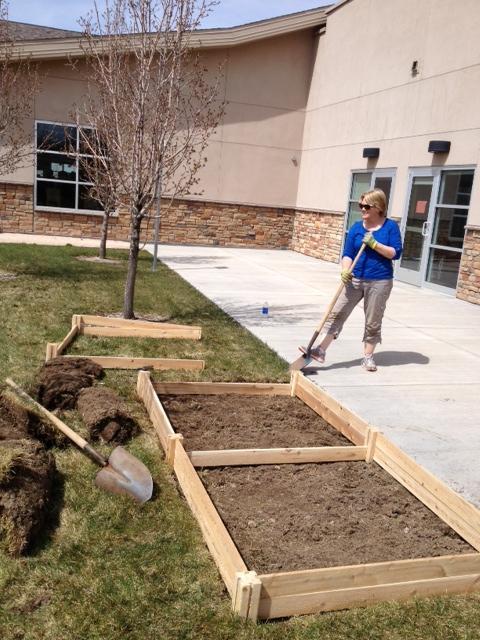
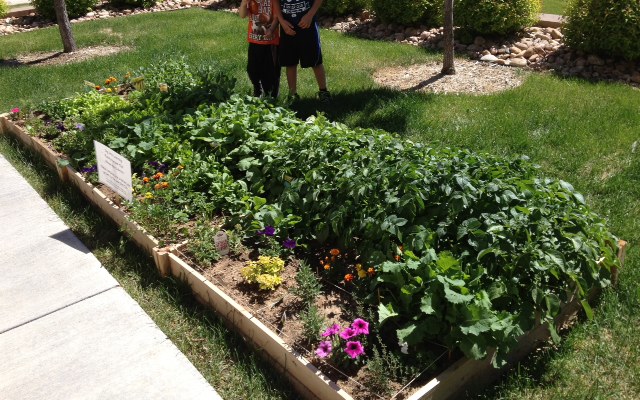
Garden Prep: Choose your spot carefully — it should be close to a water spigot and in plenty of sun. My teammate, Laurie Anne, and I built a raised bed garden (three 4×4 ft. squares purchased from Home Depot) and installed four containers. It is much cheaper to purchase soil in bulk. Our Buildings and Grounds crew picked up and delivered one cubic yard of soil. Then we shoveled the soil into the gardens.
Planning: Give yourself ample time to recruit club members so that they can help plan the garden before planting occurs in May (or whenever planting should occur given your climate). We held our first meeting in April and, with the help of our Master Gardener, Lucinda, discussed growing seasons, plant types, and planting methods. We decided to use the square foot gardening method, which means organizing your garden into squares using string and planting sticks. Then you plant just one type of vegetable in each square. This method makes it easy to designate one particular square to one particular child, and it has the added benefit of being so densely planted that weeds are hardly an issue!
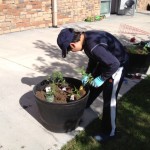
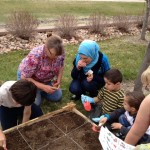
Implementation: Because we wanted our club members to learn to grow food they could actually eat, we decided to include mainly vegetables and herbs. We added a few flowers for pest control. We did the first round of planting from seed on May 5th, with some follow-up planting in June of seedlings. About 15 kids, ages 5-12, plus parents, signed up at our first meeting. We met two Sunday afternoons per month during May, June and July and for a final Harvest Party in August.
Curriculum: Each Sunday, we had some instruction time (half hour) and then some work time (half hour). Guest speakers from the local nursery and our volunteer master gardeners covered: The Importance of Bees, Botany Lesson Part 1, Worms and Composting, and Botany Lesson Part 2. We filled in the other weeks with charts and rulers for labeling parts of the plants, identifying different stages of growth, measuring growth, making comparison charts, and planting seeds for home observation. I referred most often to the curriculum of “Our Growing Place,” Spring and Summer Garden Programs, which can easily be adapted to suit your program’s length and particular needs. Check it out at http://ourgrowingplace.us/index.html. Other useful ideas came from Granny’s Garden School (www.grannysgardenschool.org) and Cornell University’s Seed to Salad Program (http://blogs.cornell.edu/garden/get-activities).
Evaluation: We all learned a lot! Our Family Garden was a successful community endeavor, relying on cooperation among parents, children, library staff, local businesses and professional gardeners. The garden created a sense of community spirit, and cultural appreciation, too. At our Harvest Party, we shared Asian, Middle Eastern and African dishes. Additionally, the garden provided STEM and family learning opportunities. By including parents, we empowered them to extend the gardening experience at home, and many did. Parents were overwhelmingly positive in their evaluations at the end of the program. They loved how educational the club was for their kids and for them. And, club members were so invested in their garden that they continued to tend it well into September on their own time.
Budgeting: Although the total cost of this program turned out to be $650, there are likely many community garden clubs that might like to contribute. And certainly ask your local nurseries for seed and plant donations. Now that the garden beds, soil, and containers have been purchased, it would cost approximately $300 to run the garden again in the same place. I would be happy to share purchasing and program planning details with anyone interested in implementing a similar program at their library.
Happy planting!
(All photos courtesy of guest blogger)
*************************************

Our guest blogger today is Betsy Brainerd. Betsy is a librarian with Child and Family Library Services in the Arapahoe Library District in Centennial, Colorado. Her focus areas include Early Literacy and Outreach. Contact her at 303-792-8999/ext. 12609 or by email at bbrainerd@ald.lib.co.us.
Please note that as a guest post, the views expressed here do not represent the official position of ALA or ALSC.
If you’d like to write a guest post for the ALSC Blog, please contact Mary Voors, ALSC Blog manager, at alscblog@gmail.com.
Dianna Burt
What a great idea! My manager will love this, too.
Kathleen Larson
We did a similar program at our library last summer. We partnered with the Master Gardeners, who won a $200 grant for us. We used a plot in the local community garden for our garden. Master Gardeners are supposed to have some type of community hours to maintain their certification and were more than happy to come and talk at our weekly meetings. The children also kept gardening journals. We are planning on continuing the program this summer. You can read more about it here: http://fromtheshortstacks.blogspot.com/2013/06/junior-gardeners.html
London Gardener
That’s a really good idea! Gardening can be used both for educational and beneficial purposes. Children can be taught to appreciate other living thing and the food they harvest themselves. They can also learn about different plants and how to grow them, and what are their health benefits. Gardening can also be used to expand one’s imagination and teach about the five senses. Not to mention that spending time in the garden with other people can help develop social skills. I wish there was such a program in hour neighbourhood as well. The kids can benefit from a gardening program and stay away from all the technology and games for a change.