Almost seven months after finding out I was the 2025 ALSC Bechtel Fellow, I journeyed down to Gainesville, Florida to officially begin my research at the Baldwin Library of Children’s Literature, and by the end of my first week, I had unearthed a secret undertone of my project that made me feel like a storytelling saver, not just an avid researcher and reader.
The Margaret Sidney collection at the Baldwin Library consists of five archival boxes filled with handwritten manuscripts, 19th century newspapers clippings, letters and old envelopes, tiny notebooks accounting for tiny payments (by today’s standards) and illustration plates from Sidney’s most famous book series, The Five Little Peppers. I began methodically making my way through the boxes, cataloging what I thought might be most useful to my research topic of her didactic prose and the installation of good citizenship in children, but then certain titles on folders began catching my eye. They were short stories and poems that I didn’t recognize from my online research, and when I unfolded them–many of them preserved in newspapers from the 1880s–I was enraptured.
One in particular, A Thanksgiving Orange, kept my attention. The illustration at its heart, captured largely in the center of the November 10th, 1887 Boston newspaper, “Our Sunday Afternoon” was black and white and featured two little girls grasping at each other as they stood in a grocer’s, and in the upper right hand corner was a little bubble showing them hugging an older man. Something about it wouldn’t slip from my mind, and when I couldn’t find any trace of the story online–not even a reference to it–I knew that my research could wait for a second, and I began to type.
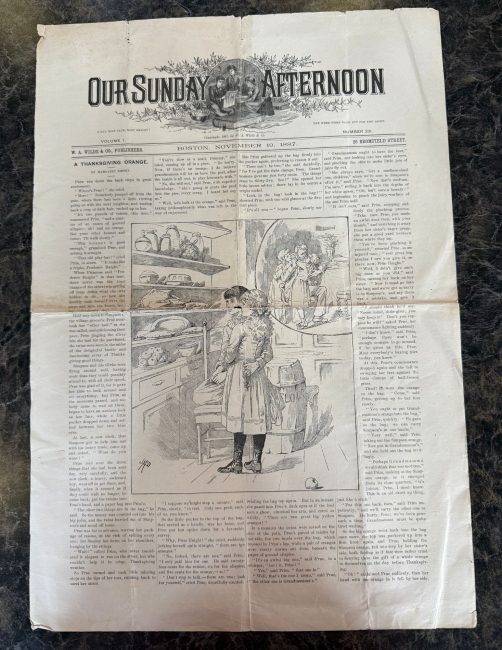
Transcribing the story from this 1887 newspaper into a Google document took me about an hour–the story is about 2600 words, and for those of us who work with children, it’s a delightful tale that feels so realized on the page. As I read it, I could think of a dozen children in my life to share it with, and now that will be even easier because I have a typed copy, not just an 1887 newspaper clipping folded into an archival box. This story can now live and breathe and be read and enjoyed again, not just studied and researched by those who happen to be in Gainesville. I felt like I had unlocked some sort of secret assignment to my research–I wasn’t just looking at the published, well-known prose of Margaret Sidney for my research, I was also getting the chance to bring her lesser known work, some of which was never digitized, into the 21st century.
A Thanksgiving Orange is the tale of twins Prim and Prue who run an errand for their grandmother to pick up ingredients for Thanksgiving baking, and instead of coming home with one orange, they open the paper bag to see two. Oranges are quite the delicacy at the time, and the girls bicker and row over what to do with the second orange before–oops–someone peels some skin, someone takes a bite, and they simply can’t return it anymore. It’s a joyous, somewhat silly, very funny story of right and wrong, the impact of guilt on a child, and the many ways an orange can be corrupted. I’ve already done one presentation on the story for the Mid-Atlantic Popular and American Culture Association, and I cannot wait to keep sharing stories like this with the world as I continue my research and bring these stories back into the world to be enjoyed.
Aryssa Damron is the 2025 ALSC Bechtel Fellow, studying the collected papers of Margaret Sidney. She is a school librarian in Washington, D.C. and the co-chair of the ALSC Children and Libraries Editorial Advisory Committee.
Jonna Smith
Such an interesting story!
medikasurgi
Great article! The information is clear, practical, and very helpful for anyone looking to understand the topic better. Thank you for sharing such valuable insights—looking forward to reading more of your informative posts.