Are you familiar with Swedish stickhandling balls? I wasn’t either until I immersed myself in the planning process for our new early literacy active learning center, The Ready to Read Railroad. The things that one learns in the library profession never ceases to amaze! As it turns out, the two-inch-diameter wooden balls rolled down and through the ramps and chutes on the magnetic wall in our STEM Depot very well. It was the sound of them hitting the tile floor that sent me on a search for quieter balls large enough not to be a choking hazard, yet small enough to fit through the chutes. I’m an expert in train bell repair now as well, but perhaps I should start at the beginning.
Our director had been interested in creating an early literacy active learning center at our library for years, so she sent me and two other librarians to Maryland to visit the extraordinary Baltimore County Public Library System Storyvilles. I found my happy place there and we came home inspired and determined to create a similar space for our community. Then Leadership Frisco, a local leadership initiative sponsored by our Chamber of Commerce, decided to make our plans for an early literacy area their class project for the year. They led a highly successful fundraising drive, raising over $180,000 for our project from local businesses and philanthropies. We hired James Bradberry and Associates, the outstanding architectural firm that designed the BCPL Storyvilles, and we were off!
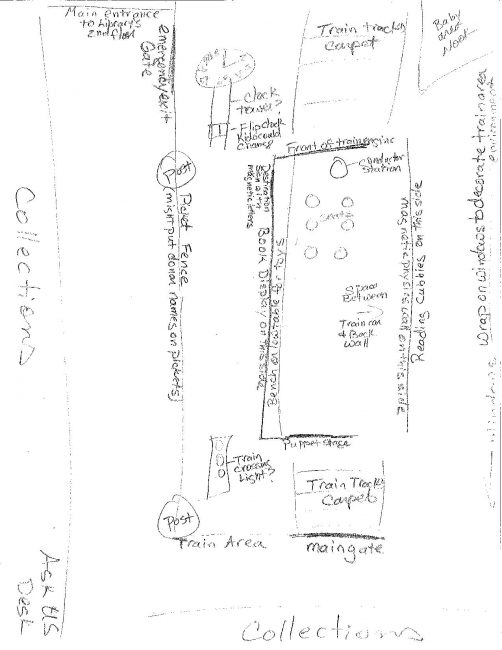
Frisco has a rich railroad history, so we knew that we wanted a train. I sent our architects this rough sketch to give them a general idea of what we wanted:
James Bradberry and Associates sent us this in return:
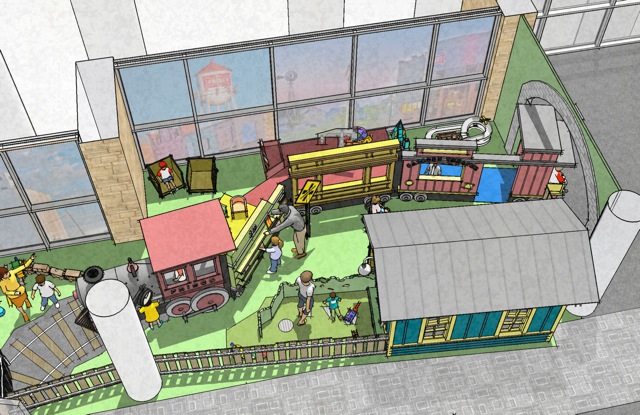
And the above, my friends, is why I am a librarian and not an architect! What followed was months of intensive planning, involving everything from working with our architects in designing each learning activity in the train to creating staff procedures to manage the new service to carefully selecting each and every toy and book for the active learning center. We worked with Safe Space Concepts in Houston, and they created fantastic custom vinyl blocks for us that look like packing crates and luggage. Do you know how many STEM activities and sets of play food include choking hazards?!? (Hand y tip: order one of the Safety 1st Small Object Choking Testers—don’t fall for the toilet paper tube test.)
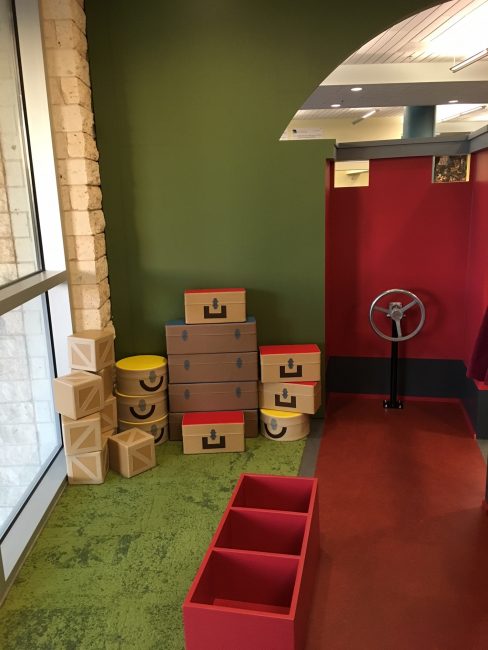

We hired TW Design in Dallas to build and install our train. Thankfully, they believed us when we told them how sturdy everything would need to be to hold up to the extensive use it would get here in Frisco. They did a superb job for us, but we still had to have the spinning train wheels and the bell repaired more than once in the first couple of weeks after our ribbon cutting. This could have a little something to do with the fact that over 17,000 children, parents and other caregivers have used our active learning center since its launch on July 23!
While the thousands of families using the active learning center report that they love it, we have had some complaints about this addition to our library. Our children’s area is on its own floor and has never been a particularly quiet space, but we have had patrons complain about the additional noise from the Ready to Read Railroad. Youth Services staff were hearing the train bell in our sleep until we finally discovered the best method for muffling it: We lined the inside of the bell with Velcro, and our facilities manager dipped the clapper in liquid rubber. Secondly, Frisco’s population is currently at 157,000 and rapidly growing. With a limit of 28 people allowed to utilize the train center at any given time to satisfy safety considerations, we purchased restaurant-style pagers to manage our waiting list. On busy weekday mornings that wait can be well over an hour. Finally, the train and its environs, like the BCPL Storyvilles, is both sized for and developmentally appropriate only for children ages five and under. It is intended to be an active learning center in which such children can engage in purposeful play with their caregivers in order to learn the skills that they will need to succeed when they start to attend school. This age limitation means that we have had some unhappy six year olds and their parents. In anticipation of this friction point, our Elementary Curriculum Lead assembled a collection of interactive Exploration Kits for children ages six and up to use in the library. These kits include a variety of STEM and literacy activities that are much more engaging for the older children than those employed in the Ready to Read Railroad. Our quest continues to discover additional activities and resources that we can add to create a more dynamic and educational elementary room.

So why did we undertake this exhilarating, exhausting journey? Ninety percent of a child’s brain develops within the first five years of life. The Ready to Read Railroad offers a wide variety of activities that have been professionally designed to encourage reading, writing, vocabulary, letter and number recognition, and narrative skills, as well as age-appropriate hands-on offerings that introduce science, technology, engineering, and mathematics (STEM) skills. Children who engage in purposeful play in their earliest years are proven to display greater comprehension, vocabulary, and cognitive skills by the time they enter kindergarten.
Now, I need to figure out a way to shave an inch or so off of the panel that was installed in the coal chute to keep kids from sticking their heads up there. The coal is getting stuck. . .
(All pictures courtesy of guest blogger)
*******************************************************************************************************************************
 Today’s guest post was written by Jennifer Cummings. Jennifer is the Youth Services Manager at the Frisco Public Library in Frisco, Texas.
Please note that as a guest post, the views expressed here do not represent the official position of ALA or ALSC
If you’d like to write a guest post for the ALSC Blog, please contact Mary Voors, ALSC Blog manager, at alscblog@gmail.com.