Welcome to Ask ALSC, where the Managing Youth Services Committee asks leaders in children’s libraries to share their response to an issue or situation. We hope to showcase a range of responses to topics that may affect ALSC members. If you’d like to respond to today’s topics, or suggest a topic for the future, please leave a comment.
Feedback Matters
How do we create a culture of trust and accountability on our library teams? Traditionally, managers provide feedback to their employees, but rarely do leaders recognize the importance of receiving feedback from their teams. However, in higher education, it’s completely normal for students to evaluate their professors. Why not normalize evaluating managers at least once a year?
The results of a 2022 study published in The Quarterly Journal of Economics by professors Shing-Yi Wang (University of Pennsylvania) and Jing Cai (University of Maryland) showed that when workers evaluated their managers on a monthly basis, turnover decreased significantly, and productivity increased.
This practice may feel uncomfortable, but it is vital for managers to embrace vulnerability. Creating channels for anonymous feedback fosters inclusion and empowers employees to share their voices without fear of retaliation
Putting Feedback into Practice: Our Survey
Bottom-up feedback can take the form of 360-degree evaluations where employees are evaluated by managers, peers, and direct reports or more focused evaluations in which employees assess their manager. In my case, I wanted to focus specifically on hearing directly from my team.
In the summer of 2023, a colleague from the Teen Department and I created an anonymous survey for our teams to evaluate our performance. Prior to sending the survey, we garnered support from our manager and ensured he was willing to review the feedback which established accountability. The survey included 10 questions in two sections:
- Section 1: Five scaled questions (1 = Strongly Disagree, 5 = Strongly Agree)
- Section 2: Five open-ended questions
This structure gave us both measurable data and thoughtful, narrative feedback.
Results: Section 1 – Scaled Questions
The first section asked team members to rate five statements.
- Manager sets appropriate expectations and manages the team’s workload equitably.
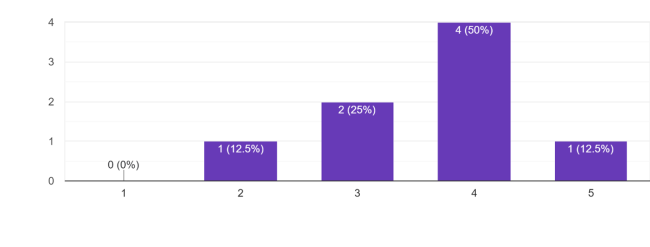
Most respondents selected 4, showing confidence in workload distribution. However, with some ratings at 2 and 3, I realized I need to be mindful about balancing responsibilities fairly across the team.
2. Manager recognizes my contributions at work.
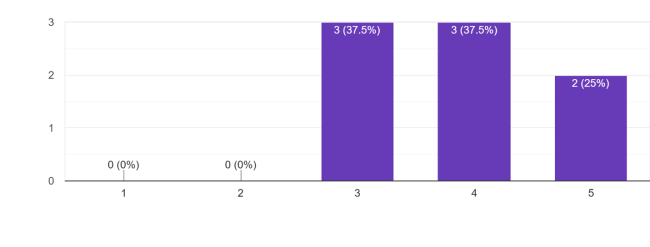
Responses leaned towards 3 and 4, with a quarter at 5. Recognition is happening but it’s not consistently felt. This reminded me to celebrate contributions in everyday moments, not just during major accomplishments.
3. Manager is responsive to the concerns put forward by me and my team.
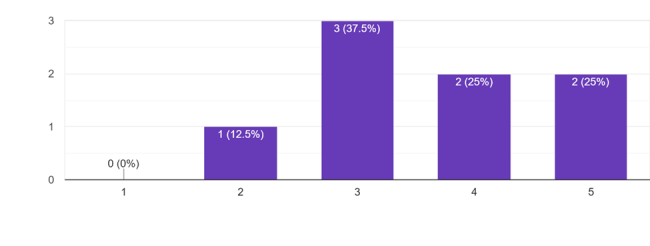
While half of the responses were 4 or 5, a noticeable number fell to 2 or 3. This told me I need to improve the speed and clarity of my responses and ensure follow-up doesn’t fall through the cracks.
4. Manager gives timely and honest feedback.
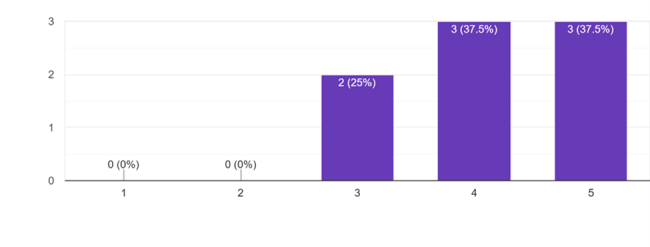
Most respondents rated this highly, at 4 or 5. That was encouraging because honesty and timeliness are areas I value.
5. Manager creates a culture of inclusivity and belonging.
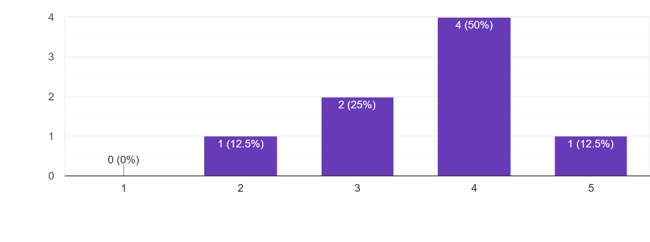
Half of the responses were at 4, with some at 5, which was reassuring. But the ratings at 2 and 3 were a reminder that inclusiveness is ongoing work and I need to continue building an environment where everyone feels heard.
Results: Part 2 – Open-Ended Feedback
The open-ended responses were especially meaningful. Some feedback surprised me at first, but after reflecting and talking with the Assistant Director, I was able to process the results and brought the results back to my team. We had an honest conversation about the feedback and talked about what it meant, where it came from, and how we could move forward. Together, we created commitments for both me as a manager and the team as a whole.
Our Commitments
| Myself | Team |
| Improve active listening | Focus on welcoming patrons |
| Be patient with mistakes | Rotate/diversify weekly programs |
| Foster open communication | Better overall communication |
| Avoid defensiveness | Build deeper connections with patrons and partners |
| Help manage stress/workloads | Strengthen collaboration |
| Address favoritism concerns | Speak up if favoritism is observed |
| Build trust | Practice mutual trust |
| Welcome new ideas | Take more initiative to build trust |
| Foster ownership | Clarify responsibilities |
| Define responsibilities clearly | Explore staffing adjustments |
Through this process, we gained a deeper understanding of one another, established healthy boundaries, and strengthened accountability on both sides, which in turn boosted team morale.
Teen Manager’s Experience
As mentioned previously, I collaborated on this project with the Teen Department Manager, Lauren Gilpin. Here is what she shared about her experience:
“I had managed my team for only two years when implementing this survey, and half of the team had been with me for less than a year. On the scaled questions, I received mostly positive rankings (3s and 4s). The open-ended questions, however, provided richer insights. Team members suggested more opportunities for collaboration with other departments, increased clarity about staff roles and patron rules, and streamlining departmental procedures.
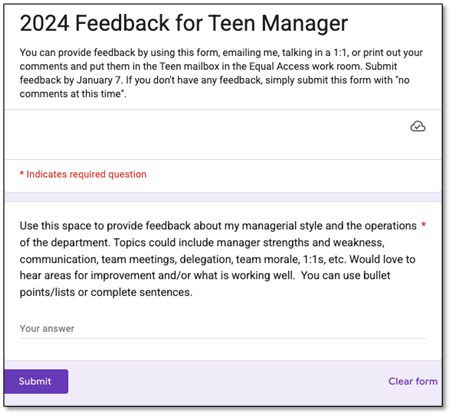
Because of these results, the following year I implemented an open-ended feedback survey (see photo below). This ensured the team knew I would continue to be responsive to their input, minimized the time required to develop the survey, and still led to constructive responses. Importantly, the team could highlight areas that mattered most to them, rather than only responding to questions I asked.
For example, I had encouraged staff to casually interact with teen visitors by assigning a daily ‘floater.’ Staff expressed discomfort with this role, and we worked together to develop a new strategy that met my goal of increased engagement with teens while addressing their concerns.
However, if you want feedback on specific areas, asking precise questions is valuable. Next year, I plan to ask the team about the effectiveness and regularity of 1:1 meetings.”
Pros and Cons of Evaluating Managers’ Performance
One of the biggest benefits of asking for feedback is strengthening leadership skills and building trust. Teams perform better when their needs are met, and upward feedback makes those needs clear.
According to People Managing People, some additional benefits include:
- Creating a positive employee experience
- Maximizing engagement and satisfaction
- Developing a high-performing workplace culture
- Fostering effective communication
- Supporting continuous improvement
- Reducing turnover and improving retention
And these are a few challenges:
- Employees may fear retaliation
- The process can feel stressful for both managers and staff
- Employees may not be honest
- Goals may fade if there is no follow-through
Acknowledging these challenges openly is part of building trust. It shows the team that you, as a manager, are not expecting perfection from them or from yourself, but that you are committed to fostering a collaborative environment where growth is both supported and valued.
In closing, receiving feedback from my team was ultimately a positive and transformative experience. The survey sparked meaningful conversations, strengthened relationships, and made me more aware of my team’s needs.
Feedback from the bottom up is not always easy, but it may be one of the most effective ways to build a culture of trust and accountability within our library teams. How do you invite feedback from your staff, and what strategies have helped you strengthen trust and accountability? Please share your experience in the comments!
If you’d like to learn more about our process or have questions about implementing bottom-up feedback in your own library, feel free to reach out:
Pat Bashir – pat.bashir@nashville.gov
Lauren Gilpin – lauren.gilpin@nashville.gov
Resources
- The Quarterly Journal of Economics, Volume 137, Issue 4, November 2022, Pages 2459–2497. https://doi.org/10.1093/qje/qjac019
- Gibbons, M. (2025). 8 effective ways to get employee feedback (+ pros and cons). People Managing People. https://peoplemanagingpeople.com/employee-retention/get-feedback-employees/
Today’s blog post was written by Pat Bashir, Children’s Services Manager at the Nashville Public Library in Nashville, TN; on behalf of the ALSC Managing Children’s Services Committee. She can be reached at pat.bashir@nashville.gov
This blog relates to ALSC Core Competencies, specifically Section VI. Administrative and Management Skills.