Several years ago, I genrefied my non-fiction collection. We committed a full school year to the project and I want to outline the process for any school or public librarians who are considering similar work.
Here are the steps involved:
- Weed the collection
- I weeded about 30% of the non-fiction collection, down from about 2800 volumes to approximately 1980
- Visual/written Inventory of Dewey Call Number Ranges
- After I was done weeding, I went through each shelf to see what our holdings were like. I was especially looking for major collection areas by Dewey range. I wrote down how many volumes we had in each Dewey range by tens (eg: 590s, 940s)
- Review School Curriculum
- I reviewed our middle school curriculum to make sure I knew what the major content/subject areas were, especially in science, social studies, health, and second language. While I know most of them already, curriculum changes and topics can go away as new ones are added (especially here in New York, it seems)
- Establish Sublocation Categories
- After reviewing our current holdings and curriculum, I created likely collection sections (called “Sublocations” in our library software). For me, the threshold was somewhere between 10-20 titles minimum for each section. Initially I had about 32 sections, and I thought that was too many, so I combined and narrowed that down to 25. Some examples of sublocations include, “Myths,” Greece & Rome,” “Coding,” and “Food.”
- Some of our categories are based specifically on research topics done here in my school, such as the middle ages.
- I paid careful attention to wording to avoid stereotypical, outdated, and gendered language in the naming of each section.


- Create Spine Labeling, Color Coding, and Shelf Label Schemes
- Books in each category were labeled with a unique spine label as well as specific section spine label protector color. For the image for the spine labels, I downloaded a silhouette image unique to each category and shrank it to fit on each label.

-
- For the protector labels, I used color label protectors available from one of the major library suppliers.
- For sublocation shelf signs, I decided to go to a local printing company and have them make “coro board” signs. They dyed the signs to match the label protectors and each sign cost approximately $8.00.
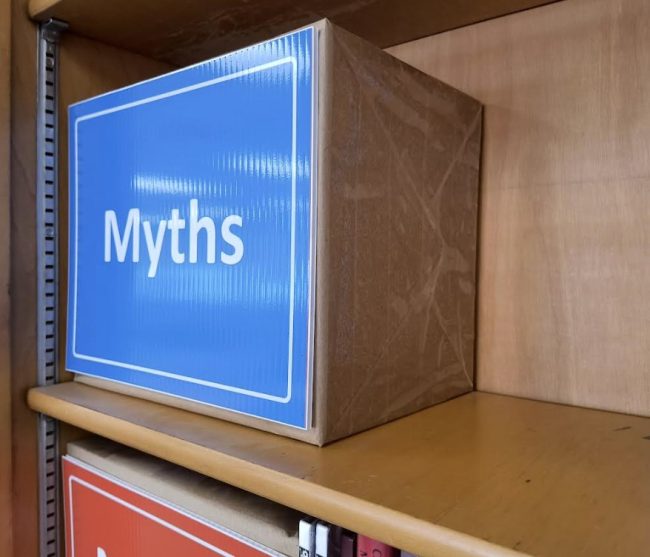
- I wanted to make the signs big enough to be read from a distance, so I went to a chain building company and had them cut 2” insulation board. My Technology teacher then cut them into specific sizes for us. I taped several pieces of the insulation board to get a 6” deep block and wrapped them in butcher paper, and taped the sublocation signs to each wrapped block.
- Physically Sort the Non-Fiction Collection into Sublocation Categories
- Sorting was fairly easy once I decided what sublocation collections to create. My principal was kind enough to hire a sub to help us with this and we were able to sort each book within two days.
- Update Sublocation for Individual Books in the Online Catalog
- Once everything was sorted, we had to assign them to Sublocations within our library catalog. Fortunately, this is pretty easy with our library software. When you create a copy record, you can assign a book to a specific sublocation. If the sublocation doesn’t already exist, you can create it on the fly. Basically, we took one book from each collection and assigned it to that sublocation in the catalog.
- The rest of the books in the sublocation could be updated via a Batch Update within our library catalog software.
- Physically Label Books with Spine Labels and Spine Label Protectors
- Since the books were already sorted by sublocation, labeling them was pretty easy.
- Put the books in Dewey order and put them on the shelf with their new sign!
- We printed a list of the holdings in each sublocation through the catalog and then put the books in Dewey order once they were labeled.
Caveats:
- We chose to maintain Dewey within the sublocations because some of our categories span multiple Dewey 100’s ranges (eg: US History and Middle Ages).
- I spent a lot of time trying to decide on which categories or sublocations to create.
- Sorting could be tricky because some of the books could fit into more than one category and I made a collection of “problem children” to decide on after the bulk of the sorting was done.
- My “Odd & Unusual” category was a bit of a catch-all for stuff that didn’t fit anywhere else.
- This also tells me where the holes in my collection are, and where I need to update basic holdings.
My Thoughts:
I’m really proud of this project. Students are browsing more instead of using the catalog, but they have less frustration and more success in finding what they want to read. The chief benefit that I’ve noticed has been that it is much easier for kids to find things on their own, and more quickly!
(All images courtesy of D. Saia)
Dave Saia is the librarian at Heim Middle School, part of the Williamsville Central School District, in Williamsville, New York. He has served ALA in a variety of capacities, including service on the 2021 Newbery Committee and chair of the 2024 Alex Award Committee. He is the current chair of the AASL/ALSC/YALSA Interdivisional Committee on School/Public Library Cooperation.
This blog post addresses the following ALSC Core Competencies:
II – Reference and User Services, subsection 1 – Creates and maintains a physical and digital library environment that provides the best possible access to materials and resources for all children and their caregivers.
IV – Collection Knowledge and Management, subsection 10 – Demonstrates a knowledge of cataloging, classification, indexing procedures, and practices to support access to children’s materials.
Kyle Flemish
Good afternoon,
I love your post by the way. I was curious on after you completed this project. Were you able to measure the success of circulating non-fiction? For example, was their a 10% increase in nonfiction check-outs from before you changed up your collection?
Thanks so much
Barb
I love this idea! I have also wanted to use colored spine label protectors, I haven’t found a company that has enough colors. I wish I knew which company you used!
CCFS
Would love to know all of your sublocations, and how you handled some of the challenging areas in the 300s, 600s, and 900s. . Thanks!
Melanie Schuchart
This is an awesome approach as I’m trying to figure out how to do this in a small volunteer only library. Can you share your sublocations? I’m especially interested in how you did animals. We are really trying to expand that section out this year. I could just put animals but I think we will have a lot. Thanks for sharing your wonderful idea. Now I just need to figure out how to implement it.