Meet Kangaroo! Kangaroo and I have been buddies since I was 4. Now, she helps me run toddler storytime.
Each week, Kangaroo lends a hand as the carrier of our letter of the week. The letter is tucked inside her pouch, sticking out just enough to invite some guesses. When we get to this big moment, I always ask her, “Is it okay to touch your belly?” and she nods emphatically.
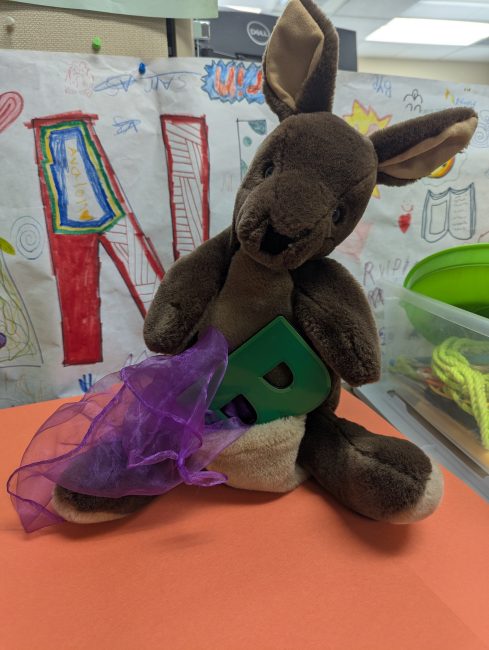
I started asking this question mostly to give Kangaroo a chance to move — a puppet with agency is a puppet children believe — but seized on the opportunity to model consent and body boundaries. Of course, a yes is only half the story. I also had to show what a “no” looked like too. So, one week, when asked our usual question, Kangaroo shook her head no.
I turned to everyone and said, “Shaking our heads means no. Kangaroo gets to choose when we touch her body, and today she doesn’t want us to. That’s okay, I see a different letter hiding over here!”
This moment was the biggest caregiver reaction I’ve ever gotten in a storytime. Eyes went wide! As I transitioned us to a search for a new letter, I watched as bafflement faded or transformed into nods of understanding. Now, Kangaroo routinely says “no”. Together, we model seeking consent and respecting a boundary.
Why prioritize modeling consent?
In storytimes already packed with early literacy tools, social-emotional awareness, and more, why is it important make room for moments like the above? As awareness of the importance of consent has grown, many caregivers are giving their children the support and language needed to make the call about their bodies. Consent Parenting and similar organizations are dedicated to spreading awareness and tips teaching even the youngest children about consent. This shared language creates a culture where children are empowered to speak up and recognize behaviors that violate their comfort.
This idea of a shared culture was at the heart of a child sex abuse prevention training I attended this fall. To prevent abuse, a wider knowledge of consent and body autonomy is desperately needed.
Ideas for your storytimes
So, beyond puppets, what can we do for little ones to model and educate about consent?
Ask for consent with humans too.
Don’t touch children without their permission. This protects both you and the child! When offering help to a child, ask the caregiver first. Then, ask the child. “Dad would like me to help you wash your hands. Could I hold your hands to help you up to the sink?” Asking the child, even with parental permission, gives them practice making a decision about their body.
Start with yes and no.
For little ones, learning yes and no is a foundational step to clearly communicating their desires. Storytime themes like opposites give you a chance to highlight yes and no within larger literacy concepts. “This is Big, Big, Big” is always a hit in the song department. For older children, it is easy to expand to sharing, bodies, and consent as topics.
Talk about bodies and emotions.
Talk about bodies and their link to emotions. Storytime action songs are all about using and labeling our bodies in big ways. We can go further and connect feelings to bodies. Try asking how an emotion feels in the body. “Show me with your whole body what sad looks like.” Children rely on understanding their emotions to read clues from their bodies to gauge their comfort.
Bring in Experts
The ALSC blog Focusing on Consent @ Storytime – ALSC Blog explores what a storytime program with a guest presenter can look like. Consider reaching out to local social workers, sexual violence prevention advocates, and others. These experts can provide additional resources to caregivers.
Librarians as models
As librarians, it is not our job to dictate how caregivers speak to their children about their bodies. We can be deliberate in how we interact with youth and the language we use, showcasing a respect for bodies and boundaries. Moreover, we can connect these practices to child safety. Every little bit we do to helps create a culture where consent in common place and children are empowered to speak out and speak up for their bodies.
Afterall, if you’ve watched a librarian protect the boundaries of a puppet, it may be easier to do the same for a child in your care.
Eleanor Howell-Shryock (she/they) is the Head Children’s Librarian, managing family and outreach services at Burlington Public Library in Burlington, Washington. They are the Chair Emeritus of the Washington Library Association’s Children and Young Adult Services Section. They are excited to highlight some of the unique challenges and opportunities of working in small and rural libraries for the ALSC blog.
Please note that as a guest post, the views expressed here do not represent the official position of ALA or ALSC.
If you are interested in submitting a guest post, please read and fill out our Guest Blogging Interest Form. We would love to hear from you!