At a public desk, digital questions rarely arrive as a curriculum. They arrive as a locked email account, a QR code, a school or benefits form, or a password that no longer works. Our Friday session on the rebooted DigitalLearn.org kept returning to a simple point: public libraries need a low-barrier tool for exactly these moments. Digital literacy starts with confidence, and confidence grows faster when instruction is short, plain, and ready to use.
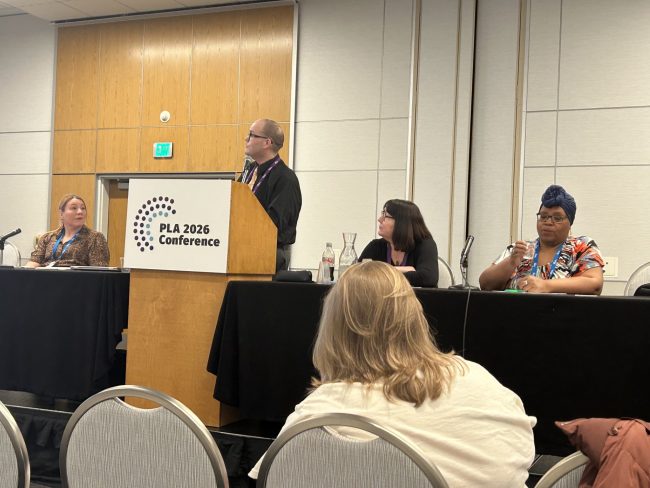
Michelle Frisque of Michelle Frisque Consulting Group, LLC, gave an overview of the platform and focused on the trainer resources already built into DigitalLearn. Kate Lapinski of Chicago Public Library explained how Chicago has used the platform for more than a decade. I spoke from the branch level about adult tech help and teen service-learning. Katina Jones of PLA shared 2025 usage data and the redesign scheduled to launch in June. Together, these perspectives showed how one platform can move across a large system, a branch interaction, a teen service-learning shift, and an outreach partnership without much friction.
Confidence Before Complexity
Lapinski traced Chicago’s use of DigitalLearn back to a 2015 question about the library’s role in the city’s workforce ecosystem. Partner after partner gave the same answer: computer help. Job seekers and adult learners could not make full use of workforce programs or educational opportunities without a stronger digital foundation.
Chicago chose DigitalLearn because it was built for public libraries, available in Spanish, flexible enough for one-on-one help or classes, and simple enough for learners at the beginning of a digital-skills journey. The point still holds. The most-used courses remain the basic ones: getting started on a computer, navigating a website, basic search, and email. Libraries often feel pressure to move quickly toward advanced content. The session made a better case for sequence. Before advanced content comes basic navigation, basic search, and enough vocabulary to make the next step possible.
Adult Tech Help, Teen Service-Learning
My own route into DigitalLearn began at the branch level. After Montgomery County discontinued Northstar Digital Literacy, I needed a replacement quickly. I wanted something free, easy to implement, and practical enough for both adult tech help and teen service-learning. DigitalLearn fit immediately.
On the adult side, I have used DigitalLearn with patrons trying to recover an email account, reset a password, fill out a government or health form, use a QR code, or navigate a website across different devices. The lessons are short, the language is plain, and the handouts, captions, transcripts, and trainer resources give both librarians and patrons something concrete to revisit after a one-on-one interaction.
On the teen side, I opened the platform to students earning required service-learning hours in Maryland. They complete approved DigitalLearn modules in the library under supervision and then write short reflections on user experience and beginning-user needs. So far, teens have completed 33 reflection forms across 11 approved courses, and 22 of the forms document a second course in the same visit. Many chose modules on video conferencing, scams, and Microsoft Word.
The reflections exposed a gap in a common assumption. Teens who live online often know how to get by, but they do not always know why a process works, what a tool is called, or how to explain it to someone else. The reflections do more than document hours. They ask teens to slow down, notice friction points, and imagine what a beginning user actually sees. This perspective-taking is part of the service-learning value. Device comfort and digital literacy are not the same. Teen services should pay attention to this distinction.
Feedback, Redesign, Reach
Jones put scale behind the branch and system examples. In 2025, DigitalLearn recorded 868,000 page views, 38,000 completed courses, and 170,000 completed lessons. More than 90 percent of surveyed learners reported greater knowledge, greater confidence, and an intention to apply what they learned. The strongest results came from the beginning courses, which is exactly where many public library learners start.
Learners wanted clearer navigation, larger text, a visible search bar, and a better distinction between courses and lessons. Trainers wanted a platform that looked more like the websites patrons already use and worked better on phones. Jones said the learner side of the reboot is scheduled to launch in June at the 2026 ALA Annual Conference & Exhibition. The redesign includes a mobile-first interface, better search, progress tracking, and new content on topics such as Bluetooth, two-factor authentication, and AI.
Frisque drew attention to the trainer side of the platform. Instructor guides, learner handouts, activity sheets, and certificates of completion mean librarians can take a course and teach it without building the materials from scratch.
One Tool, Multiple Uses
DigitalLearn works in adult classes. It also works in one-on-one branch help, outreach, job fairs, housing sites, and teen service-learning. Chicago has used it with branch staff, digital navigators, workforce settings, and housing partners. I have used it with adults at public computers and with teens completing supervised service hours. The use cases show what kind of library tool DigitalLearn is.
For teen services, two implications stand out. First, digital inclusion is often a family issue even when the person asking the question is an adult. Second, teens need more than device familiarity. They need vocabulary, structure, and guided practice.
Few digital literacy tools can support adult learners, branch staff, outreach partners, and teen volunteers without forcing library workers to rebuild the same materials each time. DigitalLearn can.
Witt Salley (he/him/his) is the Teen Services Librarian at Quince Orchard Library in Montgomery County Public Libraries. At PLA 2026, he is most looking forward to meeting colleagues whose work he has been learning from online, making new connections, and serving on the Aging Together and DigitalLearn panels. He grew up surrounded by children’s and young adult books and spent so many hours in the public library that working with teens and youth literature felt almost inevitable. If he could read one book again for the first time, he would choose Weetzie Bat for its originality and the joy of first reading it.
Please note that, as a guest post, this content does not represent the official position of ALA or ALSC.
If you are interested in submitting a guest post, please read and fill out our Guest Blogging Interest Form. We would love to hear from you!