In January, the ALSC Intellectual Freedom Committee posted about using picture books to discuss censorship. This is a timely topic, so we wanted to keep the conversation going and resources flowing. Books on book banning invite children to think about what happens when a book disappears from a bookshelf. These titles would be perfect for reading aloud and discussing how each of us has different beliefs and whether our beliefs should infringe on others. If we continue to ban or reject books, our library and classroom shelves may eventually be empty.
Read more: Continuing the Conversation: Books that Spotlight Book Banning
Same Page by Elly Swartz (2025). Bess and her friend June become sixth grade class president and vice president. They get the PTO to purchase a book vending machine, but when some books are removed from the machine due to a parent’s complaint, Bess and June’s friendship is on the rocks. The parent is June’s mom. Bess doesn´t understand why someone would want to remove books and she gets involved in The Book Warriors who fight against book-banning. Other themes in this novel include: antisemitism, anxiety, family and how friendships change.
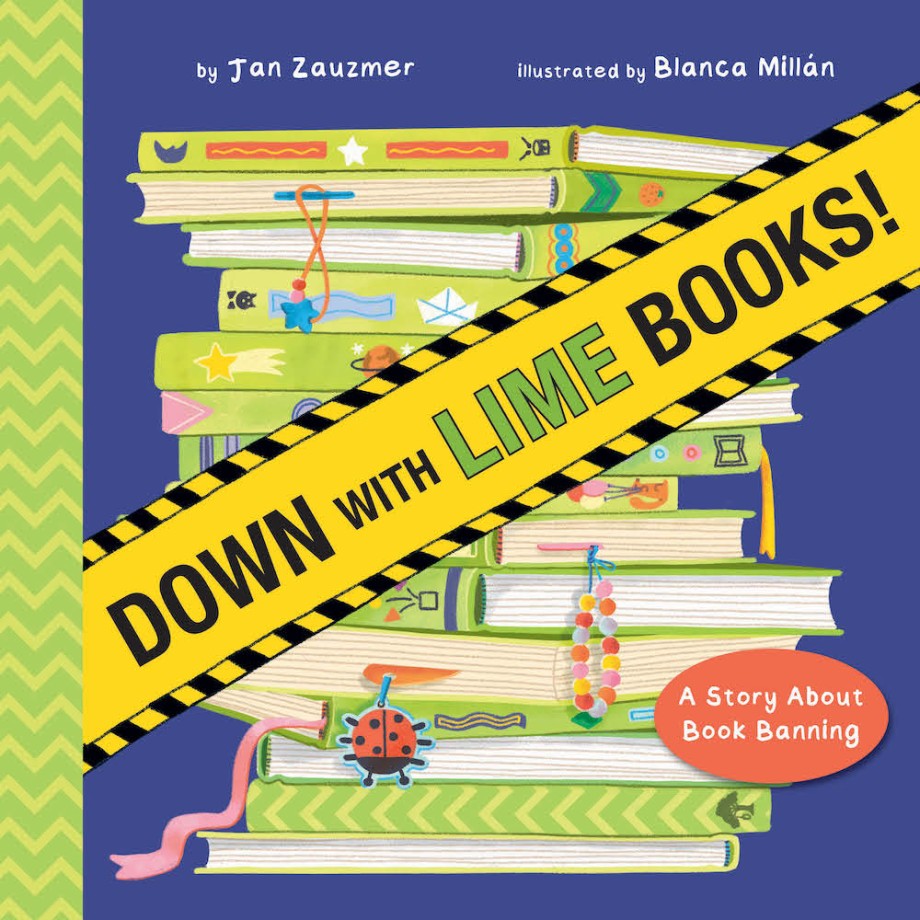
Down with Lime Books by Jan Zauzmer, illustrated by Blanca Millán (2025). Every Monday is library day when the children get to read teal books, red books and plum books. But one day a bigwig in town causes some fear in people and they decide to sneakily snatch every lime-colored book from the library. The bigwig thinks lime books should not be allowed but the children think differently and protest, “There’s no reason or rhyme / to get rid of lime. / To each bandit who banned it: / We kids won’t stand it!” Fortunately, the children’s beliefs cause the mayor to degree “The lime ban has ended!”

Jacob’s Missing Book by Sarah and Ian Hoffman, illustrated by Chris Case (2025). In this sequel, Jacob can’t find his favorite book in the school library. At lunch time he shares about the penguin book with his friends and asks his teacher to read aloud the book when the library finds it. Ms. Reeves admits that she can’t read the penguin book at story time anymore because some people are unhappy with it. She explains that while the school is trying to figure out the situation the book has been taken away along with some other titles. On the playground Jacob retells the story to his classmates, and they reenact the book by playing penguin. They gather rocks for nests and choose the perfect rock for penguin eggs. Even though the school has banned the penguin book Jacob finds a way to share it with his classmates.
Image Credits: Book cover photos taken from publisher websites in the order that they appear;
Penguin Random House, Abrams Books, Magination Press
Today’s blog post was written by Deanna Day, a children’s literature professor at Washington State University in Vancouver, Washington on behalf of the ALSC Intellectual Freedom Committee.
This post addresses the core competencies of I. Commitment to Client Group and IV. Knowledge, Curation, and Management of Materials.