
Play is powerful. Last month, I shared how Pop In Play encourages open-ended, anytime play-based learning. In May 2025, we hosted our first session with our popular ice cream theme. Here’s the inside scoop on how we planned and hosted this tasty program.
Supplies
Our Pop In Play outlines are highly customizable, so you can purchase (or repurpose) only the supplies you need for your chosen activities. We also created a program kit with reusable, shared supplies that support the theme, minimizing prep time in the building. Most reusable supplies came from items we already had on hand. After the initial creation of sets, we reuse activities from one program to the next. We also considered readily available consumable supplies and options that work well for several activities. This low-cost model supports programs that are easily repeatable and adaptable.
Program Prep
Each theme’s robust outline includes several activity choices. Facilitators choose the activities that work best with their space, and set up the room accordingly. The ice cream outline features 19 options across the five categories. Presenters select at least one dramatic play activity, one sensory play activity, two or three skill-building activities, one craft, and one movement activity. Like many of our kit programs, Pop In Play requires minimal preparation before the scheduled date. The day before the program, staff may create dough, paint, or other supplies based on the selected activities. As a come-and-go program, staff make their best guess at anticipated attendance and prepare consumable supplies accordingly. For the summer sessions, we prepared for a minimum of 50 participants based on previous program experiences.
Set Up
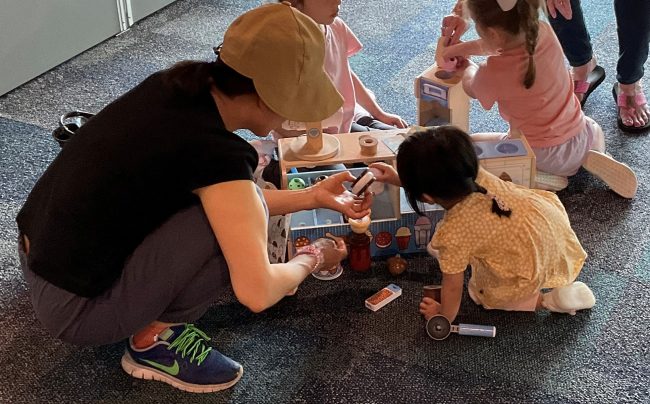
On the morning of the program, staff set up the activity stations for their building’s unique room layout and safety considerations. We intentionally space activities to allow families to explore at their own pace. Messier options include trays or mats, with staff or volunteers nearby to assist. A stroller parking area helps keep the primary area clear for play. We encourage caregivers to follow their child’s lead in play and exploration, while we are on hand to model open-ended questions and engagement and provide support if needed.
Activity Stations
Here’s a sample of what families experienced at the first program:
| Category | Activity | Supplies Needed | Objective |
| Dramatic Play | Cool Scoops Creamery | Assorted puppets, Cool Scoops Creamery, order cards, play money | Offer pretend play ice cream, soft serve, milkshakes, and ice cream sandwiches. |
| Sensory Play | Fluffy Slime | Beads, craft poms, clear vanilla, food coloring, mixing bowl, plastic bowls, plastic cones, plastic scoops, saline solution, shaving cream, spoon, strawberry Jell-O, unsweetened cocoa powder, white school glue | Build pretend ice cream masterpieces with slime and top with desired toppings. |
| Skill Building | Number Matching | Number pops | Explore numbers and counting through a matching game. |
| Skill Building | Color Matching | Color matching sets | Explore colors by matching each scoop to the appropriate cone. |
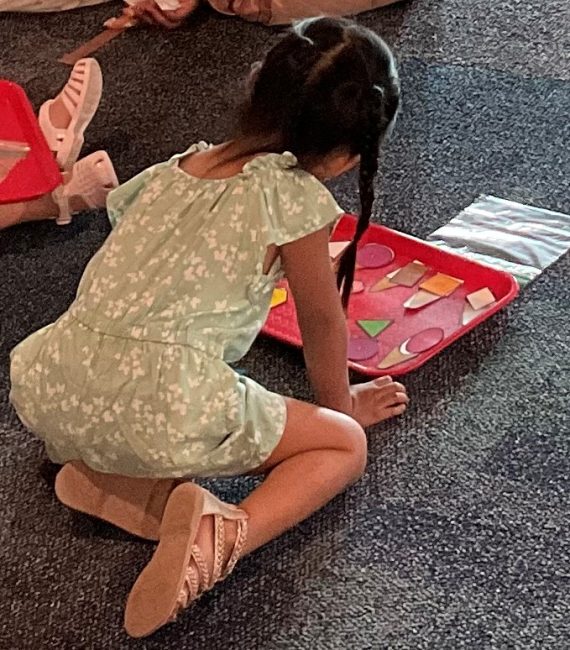
| Skill Building | Ice Cream Shapes | Shape matching sets | Practice shape recognition by matching each shape to the correct cone. |
| Craft | Cupcake Liner Ice Cream | Cardstock, construction paper, cupcake liners, glue sticks, plastic forks, stickers, glitter, craft jewels, washable paint | Create and decorate your own ice cream cone. |
| Movement | Ice Cream Cone Relay | Bins, masking tape, scoops and cones | Practice balance and gross motor movements as you move ice cream scoops from one end of the relay to the other. |
Alternate Activities
Here’s a menu of other activities not used, but available in future programs.
| Category | Activity | Supplies Needed | Objective |
| Dramatic Play | Ice Cream Dice | Ice cream pieces, pocket dice cards, pocket dice | Create your own ice cream masterpiece by following the directions on the cards as you roll the dice. |
| Sensory Play | Ice Cream Dough | Beads, craft poms, bowls, cornstarch, food coloring, hair conditioner, imitation extracts, plastic bowls, plastic cones, plastic scoops | Create pretend ice cream masterpieces with dough and top with desired toppings. |
| Sensory Play | Sensory Bin | Medium container, plastic bowls, plastic cones, plastic scoops, sequins, small bowls or cups, white cotton balls or craft poms | Children can make their own ice cream treats with the provided supplies. |
| Sensory Play | Sensory Bags | Baking soda, cardstock, craft poms or pipe cleaners, gallon zipper bags, hair gel, masking tape | Explore letters and sounds through a matching game. |
| Skill Building | Alphabet Matching | Alphabet matching sets, masking tape | Explore letters and sounds through a matching game. |
| Skill Building | Ice Cream Patterns | Pattern sets | Explore patterns by completing each pattern with the appropriate scoop. |
| Skill Building | Sprinkle Writing Trays | Box lids, cardstock, colored straws, craft trays, paintbrush | Use paintbrushes to sweep the sprinkles onto the picture and decorate an ice cream cone. |
| Craft | Ice Cream Cone Puffy Paint | Baking soda, construction paper, construction paper, flour, food coloring, glue sticks, markers, paintbrush, salt, scissors, small bowls or cups, watercolor paint trays | Create a unique ice cream artwork. |
| Craft | Sponge Painted Ice Cream | Cardboard, cardstock, construction paper, glue sticks, scissors, small bowls or cups, sponges, washable paint, watercolor paint trays | Design your own masterpiece using paint to create ice cream scoops. |
| Craft | Paper Bowl Ice Cream | Cardboard, craft poms or pipe cleaners, glue sticks, markers, paper bowls, scissors, washable paint | Create and decorate your own ice cream cone. |
| Movement | Pass the Ice Cream | Cardstock, clear tape, markers, ruler, scoops and cones | Practice passing the ice cream cone from one person to the next. |
| Movement | Movement Dice | Movement pocket dice cards, pocket dice | Roll the dice and attempt the movement listed. |
Tips and Feedback
Our first session had over 100 attendees. Throughout the summer, we continued to see high numbers, with no fewer than 40 attendees at any session. Next, we’ll continue to offer the programs (and add new themes) through the fall and spring sessions. In addition, we’ll gather feedback from staff and patrons.
- Plan for plenty of attendees. While we expected the programs to be popular, they had higher attendance than many of our other early learning programs. The numbers may be a result of summer, but it’s good to plan for a big crowd.
- Experiment with your activities and layout. We added more skill-building activities because they were low prep and easy to set up. However, we had to balance the number of activities in the room with the number of people. Setting up most activities around the perimeter of our space made it easier for families to move between activities and still allowed plenty of space for play.
- Double up on messy play. Our sensory activity was one of the most popular stations. While we made one batch of each flavor, we could have easily used twice as much slime. Plan for extras here – trust me, you’ll need it. Prepare activities at least one day ahead for a smooth day-of experience.
- Don’t hold too fast to your expectations. While each activity included guidance on how to complete it, the best connections grew from spontaneous play and exploration. By giving families the freedom to choose, we increased engagement, excitement, and learning opportunities.
- Know when to step back. As program facilitators, we wanted to be hands-on and engaged in play. However, we found that most caregivers didn’t need our support. We learned to balance checking in with families and monitoring the room, while giving families space to engage with each other.
Next Steps
Ice cream was a fun and flexible theme that engaged families at several buildings this summer. The mix of activities makes it easy to create unique program experiences even if offered multiple times per session. If you’d like to know more, you can reach me via email or by adding a comment. What playful themes would your families enjoy exploring at your library?
This post addresses ALSC Core Competency #3: Programming Skills. All photos provided by Jaime Eastman, ALSC member.

Jaime Eastman is a senior Public Services Librarian and Early Learning Coordinator at the Harrington Library, one of the Plano (Texas) Public Library locations. Jaime is also working on at least two ambitious cross-stitch projects, dreaming of future travel plans, and reading far too many books. As a child, she wanted to grow up to be an author. Writing for the blog and publishing with Children and Libraries feels like a good start, and she regrets nothing about her adult decision to be a librarian doing storytimes, who didn’t have to grow up too much.