There’s a scene in the cult film Little Miss Sunshine where an endearingly dysfunctional family is driving cross-country to a beauty pageant. At one point the alleged grown-ups get into a heated argument about adult life-style choices. Young Olive, our seven-year-old heroine, is blissfully tuned into her music, but sensing the rising tension, pulls off her headphones and wants to know what everybody’s yelling about. After a moment of adult topic-inspired hesitation, Grandpa comes up with a one-word response: Politics. Thoroughly disinterested, and slightly disgusted, Olive returns to her music.

Commons
Would that all of us could so effortlessly dismiss this loaded subject.
However, we live in interesting times, and no matter where people fall on the political spectrum, we all face a never-ending barrage of media coverage about government actions and our elected officials. Some adults may think children are impervious, but kids can be pretty savvy. They certainly hear broadcasts and see headline teasers; they’re definitely tuned into any family or community tension.
And, as too many of our colleagues know first-hand, sometimes public or school libraries can become the focus of community tension. Fully cognizant of our duty to inform and educate young users, but also aware of the need to respect all views during this time of heightened politicization, how can libraries offer balanced, reassuring support?
One solution is through book displays and other passive programming. It’s important that these displays reflect non-partisan neutrality and emphasize finding solutions, not due to political cowardice but in an attempt to get information to as wide an audience as possible.
All librarians seek to curate collections that meet the needs of their unique communities. Balanced introductory materials that pique kids’ interest can naturally segue into more nuanced titles should additional questions come up.
Here are a few recent titles to get kids thinking:
I Voted: Making a Choice Makes a Difference. By Mark Shulman. Illus. by Serge Bloch. 2020. 40p. Holiday/Neal Porter. (9780823445615). K-Grade 2. 324.6.
This simple book talks about making choices. People choose, but they don’t always get their own way, or win, or manage to change people’s minds. The focus moves from options like ice cream or onions? to bigger issues like national elections. Straightforward language, relatable examples, and funny illustrations help make this accessible to young audiences.
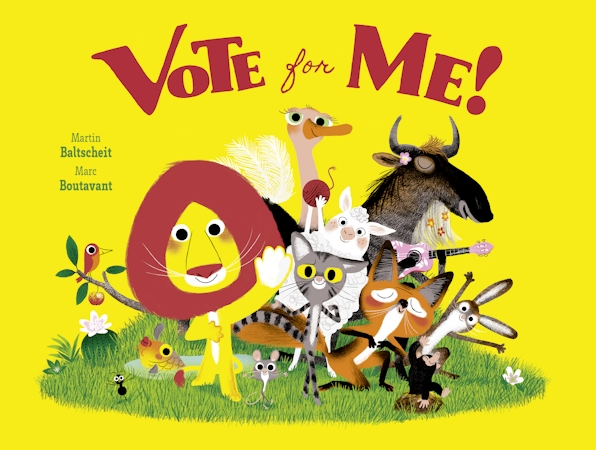
Vote for Me! By Martin Baltscheit. Illus. by Mac Boutavant. 2020. 40p. Eerdmans, (9780802855435). K-Grade 2.
The animals have always voted for Lion to be president, but when a mouse says that uncontested elections are pointless, things change. One of each animal decides to run, so each candidate receives one vote, except Lion, who didn’t vote at all. Chaos reigns until Lion is called upon to please restore order. An effective choice for introducing elections.

George Washington’s Spectacular Spectacles: The Glasses That Saved America.By Selene Castrovilla. Illus. by Jenn Harney. 2025. 32p. Astra/Calkins Creek. (9781662680434). Grades 2-5. 973.3.
George Washington kept his need to wear glasses a secret until 1783, when he first wore them in public while responding to some treacherous mutineers. Silence fell as his officers realized their former general was aging, and full of remorse, the angry men halted their uprising. An empathetic look at an obscure episode in early American politics.
The Next President. By Kate Messner. Illus. by Adam Rex. 2020. 48p. Chronicle. (9781452174884). Grades 2-5. 973.09.
This cool picture book makes connections between presidents who lived at the same time (example: when JFK was elected in 1961, Gerald Ford was in Congress, Ronald Reagan was a TV star, Bill Clinton, George W. Bush, and Donald Trump were teenagers, and Barack Obama was a baby). This is a really sneaky way of getting kids to start thinking think about their own presidential futures.

History Tipsters Go to the Polls: The Inside Scoop on Voting and Elections. By Jessica Gunderson. Illus. by Luiz Fernando Da Silva.2024. 32p. Capstone. (9781669076193). Grades 3-5. 324.60973.
This history comic introduces voting and the U.S. electoral process, covering polling, vote counting, and a bit of kid-friendly trivia. Engaging and dynamic illustrations help the content go down nice and easy, and there’s ample back matter that fills in additional information. The History Tipsters series offers especially engaging curriculum support.
Future Vision: Stories of Our Brilliant Tomorrow. By Cathy Rogers. Illus. by Madeleine Rogers. 2025. 56p. Button. (9781787081505). Grades 3-7. 333.72.
This is a futuristic guide to everyday life in London in the year 2070. Daily interactions highlight innovations in transportation, conservation, housing, AI, energy, food, and democratic societies. Steeped in realistic optimism, this unique and upbeat STEAM offering has multiple curricular applications and is sure to spark curiosity.

We the People: Big Ideas that Changed the World #4. By Don Brown. Illus. by the author.
2022. 128p. Abrams/Amulet. (9781419757389). Grades 4-7. 741.5.
In this graphic history, Abigail Adams (John’s wife) introduces various democratic societies and emphasizes the roles of little-known heroes and villains in America’s story. There’s a substantial amount of information set off by engaging art that really pops. There’s also plenty of additional back matter content to help with reports.
A Quick History of Politics: From Pharaohs to Fair Votes. By Clive Gifford. Illus. by Steve Gavanuly. 2021. 128p. Wide Eyed. (9780711262744). Grades 4-7. 320.
This graphic guide introduces forms of government (theocracy, monarchy, democracy, feudalism, communism, and fascism) and reviews issues related to voting and elections (suffrage, lobbyists, media influence, etc.). There’s a balance of background information and fun facts supported by an illustrated timeline, quiz, glossary, and related resources.
Make Your Mark, Make a Difference. By Joan Marie Galat. 2024. 352p. illus. Aladdin/Beyond Words. (9781582708447); Aladdin/Beyond Words. (9781582708454). Grades 4-8. 303.4.
Line drawings and graphics, lists, quizzes, prompts, multiple sidebars, and other helpful features (embedded vocabulary definitions; detailed chapter notes) make this an inspiring manual that offers realistic and creative suggestions that will appeal to all kinds of kids and potential activists and hopefully encourage our next generation of changemakers.
Kathleen McBroom, School Library Practicum Coordinator, Wayne State University School of Information Sciences, Detroit
This post addresses the following ALSC Core Competencies: I. Commitment to Client Group, II. Reference and User Services, III. Programming Skills, IV. Collection Knowledge and Management, and V. Outreach and Advocacy