As the sun begins to set earlier and earlier, you might find yourself slipping into a wintry mindset of cozy blankets, hot chocolate, and possibly snow. In December 2023, I wanted to create a program with all of these cozy winter-y feelings, without any religious ties. This led me to using the solstice as the basis for such a program.
This year, on December 21st, the northern hemisphere will officially transition into the winter season with the arrival of the solstice. While many of us know that this brings the shortest day of the year, we may not know much else about this special day. After conducting my own research, I created a 90-minute program to teach the science behind the solstice, as well as its traditions from a variety of cultures.
For the “learning” portion of the program, I started off with a bit of trivia. I listed “facts” like “The solstice is the coldest day of the year” or “The solstice is the first day of winter” one at a time. Then, the kids had to go to one side of the room if they thought a fact was true and another side if they thought it was false. We then reviewed the correct answer and learned about why something was true or false. I then shared a story about the solstice titled The Shortest Day by Susan Cooper.

I aimed to stress that many people who celebrate the solstice are celebrating the return of the sun, not necessarily the beginning of the “cold season”. Once we reach the shortest point of the year, we can only oscillate back to the longest! After this structured portion of the program, we transitioned into self-directed stations of games and crafts.
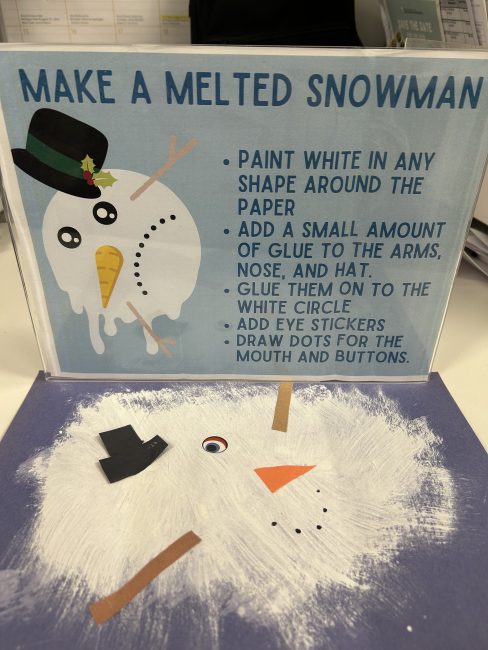
At my library, I know that programs such as these attract a wide array of ages. There might be toddlers with caregivers helping them complete activities or there could be elementary school children who are completing the activities by themselves. In my planning for the program, I tried to keep all of these age groups in mind. For our stationed activities, I selected at least two activities for each age group that I thought would attend, plus some generic activities for “all ages.” For the youngest group, ages birth through five, I created a sensory bin as well as a melted snowman craft. The sensory bin allowed the children to explore differently textured white objects (snow) and search for winter themed animals (polar bears, penguins, etc.). The painting activity allowed children to paint freely with white paint on their paper. Melted snow can look any way!
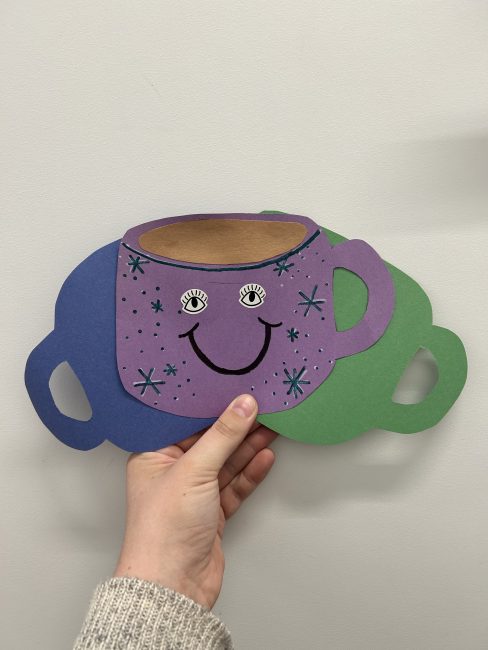
For the preschool through 2nd grade crowd, there was a station for decorating a mug of hot chocolate and another to lace cardboard snowflakes. The hot chocolate station involved gluing, cutting, and coloring. The snowflake lacing cards involved threading different colored yarn through pieces of cardboard to create a snowflake shape. This required a lot of hand/eye coordination as well as fine motor skills that I thought was perfect for this age group. The next and last group that I prepared for were the school aged kids, 2nd through 6th grade. For these children I set out homemade salt dough with cookie cutters, string, and different cutting tools that they could use to create their own ornament. I tried to provide a variety of winter-themed cookie cutters, but I also provided some shapes I thought they might enjoy like hearts and letters. Additionally, I offered them bookmarks to decorate that were winter themed. They really enjoy intricate and detailed coloring activities. In addition I had games like pin the nose on the snowman that all children could participate in.
Overall, this was a rather successful program here in DC. While it did gather a small crowd, it also taught participants about the Winter Solstice and how different areas of the world celebrate it. They were able to learn hard facts about what the solstice is and is not. To me these are the true measures of the success of a program as well as how engaged participants were, and these friends were highly engaged. Let’s just say that at the end of our 90 minutes together … I had to pry several kiddos away from their projects to clean up. Larger scale thematic programs like these are something that our community really looks forward to throughout the year, and I am excited to (hopefully) bring a solstice program back this December!
Today’s guest contributor is Annaliese Melvin (she/they). Annaliese is a children’s librarian at a neighborhood library in Washington, D.C. Originally from Pennsylvania, she moved to the DC-area in 2020 to become a special education teacher after graduating from Arcadia University. In 2023, she graduated from the University of Southern Mississippi with a degree in Library and Information Science and transitioned into the library field. She is passionate about equity, inclusion, reading, and Philadelphia sports.
Please note that as a guest post, the views expressed here do not represent the official position of ALA or ALSC. If you are interested in submitting a guest post, you can learn more here and fill out our Guest Blogging Interest Form.
Suzi
What an awesome program!!